
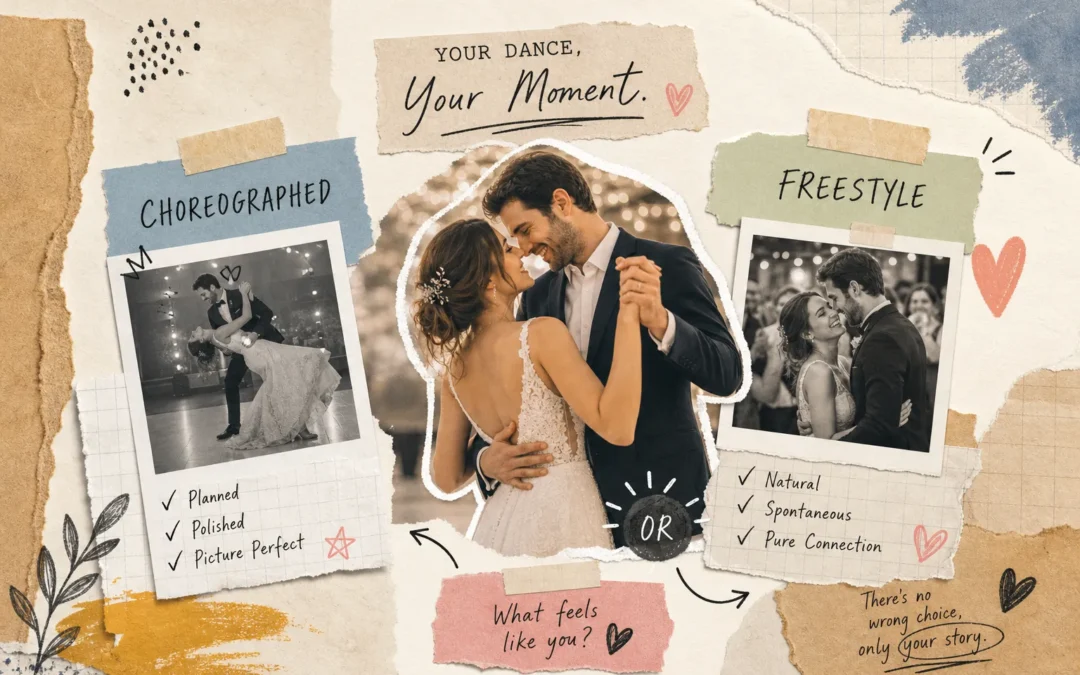
If you’ve been asking yourself “should I get a choreographed or freestyle routine for my wedding dance?”, you’re not alone, and the answer isn’t as straightforward as most people expect. Picture this: your song begins, the lights shift, and every person in the room turns to watch you. For a few seconds, you and your partner are standing on the edge of the dance floor wondering whether you’ve prepared enough, or at all. It’s one of the most watched moments of the entire wedding day, yet the question most couples wrestle with in the months beforehand feels deceptively simple: should we plan every step, or just move to the music?
The honest answer is that choreography versus freestyle isn’t a binary choice. There’s a full spectrum between a fully rehearsed routine and a spontaneous sway, and the right approach depends on your skill level, your timeline, and what you actually want to feel in that moment. Dance instructors who specialise in wedding couples work with people across this entire spectrum, from complete beginners building a polished routine from scratch to confident movers who just need a bit of structure and a few practised moments to feel genuinely ready. At Wedding Dance Lessons Sydney (Suave Dance Studio), that breadth of experience is exactly what shapes the guidance couples receive from their very first session.
What choreography and freestyle actually mean in practice
A fully choreographed first dance means specific steps set to specific counts in the music, a defined start and finish, and movements that match the emotional arc of the song. That doesn’t necessarily mean theatrical lifts or complex footwork. Even a simple close hold with a well-timed dip at the bridge counts as choreography when it’s intentional and practised. The couple knows exactly what they’re doing and when, which is what makes it look controlled rather than accidental.
Freestyle means responding to the music without a fixed sequence, but this is not the same as winging it. Good freestyle still requires body awareness, clear lead-and-follow communication between partners, and genuine comfort with physical connection on a public floor. Couples who attempt freestyle with no dance background at all often describe the experience as more stressful than they expected: without a plan to fall back on, nerves tend to produce shuffling rather than dancing.
The option most couples land on, especially when working with an experienced instructor, is partial choreography: a structured opening 30 seconds covering the entrance and first move, a freestyle middle section, and a choreographed close with a dip, spin, or signature moment. This approach gives couples a safety net at the most-watched moments while preserving the spontaneous feel they’re after.
Should I get a choreographed or freestyle routine? How rehearsal time compares
A basic choreographed routine with simple steps and one dip typically requires six to nine total hours of rehearsal, split between lessons and home practice. An intermediate routine with turns, transitions, and more complex footwork pushes closer to twelve to twenty or more hours spread over three to four months. That’s the real cost of looking genuinely polished rather than just adequate, and it’s worth understanding upfront so you can plan your timeline accordingly.
Freestyle is not the low-effort option people assume it is. Two or three focused lessons on lead-and-follow mechanics, body positioning, and how to move together comfortably can transform a stilted freestyle into something that reads as natural and confident on video. Without any preparation at all, couples tend to freeze during quiet moments, lose their footing during transitions, and spend long stretches simply stepping side to side with no real sense of direction.
Preparation is also the most effective way to manage performance anxiety on the day. A choreographed routine gives you a mental script to run on autopilot when adrenaline spikes: you don’t need to think, you just execute what you’ve rehearsed. Freestyle requires a different kind of confidence: the ability to stay present and responsive rather than follow a plan. Neither approach eliminates nerves entirely, but a rehearsed routine gives most couples something concrete to hold onto when their minds go blank in front of a hundred guests.
How your song shapes the decision: choreographed or freestyle for your wedding first dance
Songs with a clear structure (verse, chorus, bridge, and key change) tend to reward choreography because the emotional peaks in the music create natural moments to land a turn, a dip, or a meaningful pause. Upbeat songs with a defined rhythm, such as Salsa, Waltz, or Foxtrot tempos, are genuinely difficult to improvise to convincingly without some form of planned footwork. Most first dances are also edited down to around two and a half to three minutes; choreography works best when the couple’s movements are designed around specific sections of a trimmed track rather than the full four-minute version.
Slow, tempo-flexible ballads with minimal rhythmic structure are more forgiving for freestyle because there’s no obvious beat to miss. Songs where both partners have a strong emotional connection also tend to encourage natural movement even from non-dancers. That said, even a freestyle-friendly ballad benefits from one or two practised moments: knowing where the key change hits and having something planned for that section transforms a freestyle dance from aimless to intentional.
One practical recommendation the team at Wedding Dance Lessons Sydney consistently makes is to lock in your edited track early. The editing process itself often clarifies which sections to choreograph and which to leave open, and reverse-engineering your approach from the music is far more effective than choosing a style first and then trying to fit it to the song.
What each approach looks like on camera
Most wedding videographers will tell you the camera sees everything that the live crowd glazes over. Awkward weight shifts, lack of physical connection, aimless movement, and visible uncertainty all register clearly on footage. A choreographed routine, even a simple one, gives the videographer defined moments to anticipate and capture: the first spin, the dip, the close-hold section where the couple looks genuinely connected, the elements that help you make your first dance moves memorable.
Venue constraints matter here too. A small reception space may make expansive choreography impractical, and a polished timber floor behaves very differently from a lawn or marquee surface when attempting turns. Dimly lit venues flatten movement and make detailed footwork invisible on camera. For couples whose venue has limitations, a tightly structured but spatially economical choreographed routine often reads far better on film than a sprawling improvisation in a challenging space.
What each path actually costs in time and money
Single private lessons in Australia range from around $80 to $250 per hour, and full choreography packages covering lessons and music guidance run from $1,100 to $2,900 depending on complexity and location, with Sydney packages sitting towards the higher end of that range. Think of this not as an expense but as wedding-day insurance: the investment covers personalised choreography, music editing guidance, and the kind of rehearsed muscle memory that holds up under pressure when you’re standing in front of everyone who matters to you.
Wedding Dance Lessons Sydney offers clearly structured package options to take the guesswork out of budgeting, with tiers designed around realistic preparation timelines so couples aren’t left wondering whether they’ve done enough work before the day arrives. If you want to explore how to make your first dance unique with wedding dance classes, the studio’s packages provide a useful starting point. For broader local options, marketplaces for wedding dance lessons can help you compare teachers and prices.
Choosing to go freestyle without any instruction is often framed as free, but the cost shows up differently. There’s the regret that surfaces when reviewing the footage, the low-level anxiety that lingers for months before the wedding, and the missed opportunity to create a moment that genuinely reflects who you are as a couple. Two or three structured lessons to establish body awareness, lead-and-follow basics, and a few practised moments is a modest investment that changes how confident a freestyle approach actually feels when the music starts. You can also consider established studios such as Ascendant Dance Company if you’re looking for specialist wedding-focused instruction.
A simple framework for making your decision
A few honest questions will clarify your direction quickly. How much lead time do you have? Less than six weeks points toward a simple choreographed structure with a few key moments rather than an elaborate routine. With three to four months up your sleeve, a fully choreographed intermediate routine is realistic. Beyond timing, consider how comfortable you are with uncertainty on the day, if neither of you thrives without a plan when the pressure is on, hiring a wedding choreographer is the safer choice regardless of skill level. Finally, what do you actually want to feel during the dance: accomplished and precise, or present and spontaneous? Both are valid, and both are achievable with the right preparation. For a practical read on methods and structure, this piece on how to choreograph a dance covers useful choreography basics.
Whether you choose full choreography, partial choreography, or a structured freestyle approach, a few sessions with an experienced instructor removes the guesswork from all three paths. Wedding Dance Lessons Sydney at Suave Dance Studio works with couples across all three approaches, building polished choreographed routines from scratch, adding structure and confidence to freestyle dancers, and helping couples choose and edit their song so they walk into their reception genuinely ready. The studio recommends booking at least three to four months out for a fully choreographed routine, and notes that even two focused lessons can meaningfully change how a freestyle first dance looks and feels on the day.
Your first dance, your way
Whether you should get a choreographed or freestyle routine for your wedding dance ultimately comes down to how much time you have and how you respond to pressure on the day. Neither choice is wrong. A heartfelt sway to the right song can be just as powerful as a technically polished routine. The real difference is intention and preparation.
Couples who put in even a small amount of deliberate practice, regardless of which path they choose, consistently feel more confident and more present during the moment itself. They stop worrying about what they look like and start actually experiencing it. That shift, from nervous performance to genuine celebration, is what makes every session worthwhile. If you’d like specific guidance on finishing your routine with impact, see tips on how to know how to end your first dance performance.
If you’re still weighing up whether to get a choreographed or freestyle routine for your wedding dance, one conversation with an experienced wedding dance instructor will make the decision straightforward. Reach out to Wedding Dance Lessons Sydney to talk through your timeline, your song, and your goals. For further reading on first dance choreography approaches you might also find practical advice at wedding first dance choreography.