
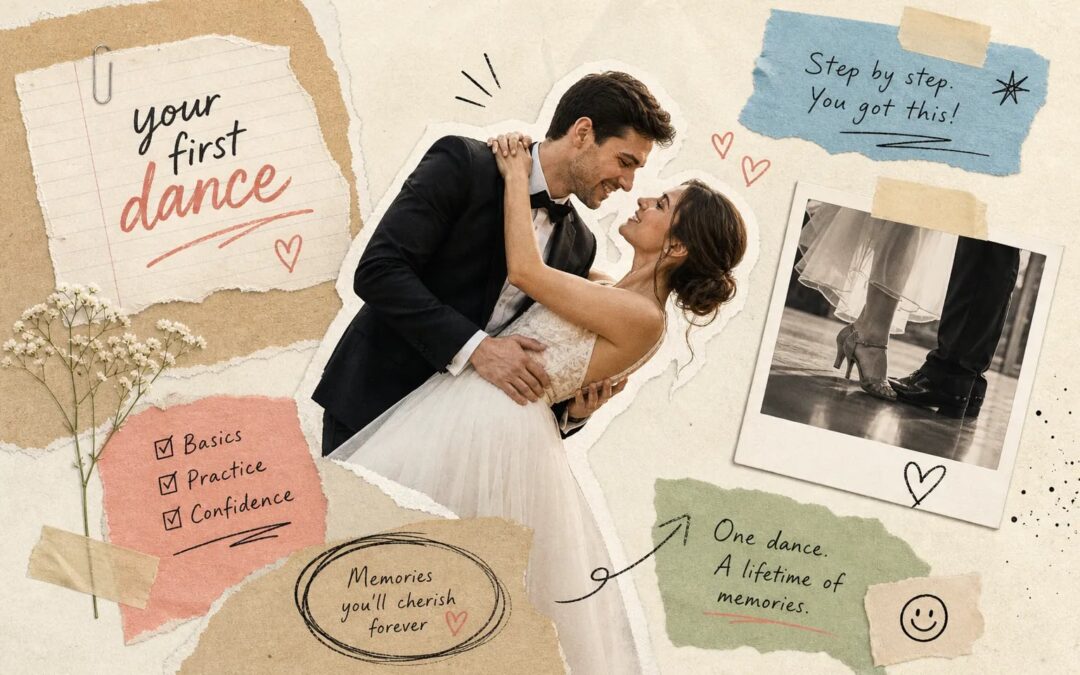
Picture the moment: every guest watching, glasses raised, two people standing in the middle of a dance floor wondering what on earth to do with their feet. If you’re asking how a complete beginner can learn a wedding dance in time, you’re in very good company, that particular anxiety visits nearly every couple planning a wedding, regardless of how confident they are in every other part of their lives. The good news is that “no experience” is not the obstacle it feels like. It is simply a starting point.
The real difference between couples who walk off the dance floor glowing and couples who muddle through is not natural talent. It is having a clear, structured plan from the very first session. At Wedding Dance Lessons Sydney (Suave Dance Studio), instructors work with complete beginners every single week through tiered packages built specifically to get couples stage-ready within a set number of lessons, no prior dance background required. Studios like this typically offer packages ranging from around ten lessons through to twenty or more, each designed to meet couples wherever they are and deliver results before the big day.
By the end of this guide, you will know exactly how much time you need, what happens in each lesson, how to structure your home practice, and how to walk onto that dance floor feeling genuinely confident rather than just hoping for the best.
Can a complete beginner learn a wedding dance in time?
Yes, and here is why. What absolute beginners actually need to learn is a small, coachable set of physical skills: posture, basic weight transfer, moving in time with music, and responding to a partner. None of these require natural talent. They require instruction and repetition. As a general guide across the industry, a simple two-to-three minute first dance is completely achievable for a complete beginner with around four to seven private lessons, provided the choreography is matched to the available timeline.
The distinction that matters is not whether you can dance, it is whether your expectations match your time. A couple with four weeks and a waltz box step will look far more polished than a couple with four weeks attempting Argentine tango. The style and the timeline have to work together, and that is a conversation a good instructor will guide from the very first session.
Beginners who struggle usually do so because they are trying to learn without a framework: watching a handful of YouTube videos, choosing a song with an unpredictable rhythm, or picking up ambitious choreography with no one to correct their errors before those errors become habits. A structured lesson programme removes the guesswork. Skills are introduced in the right order, foundations are established before any choreography is layered on top, and progress builds in a sequence that actually makes sense. That structure is what separates productive preparation from stressful preparation.
Your wedding dance timeline: what is realistic at every deadline
Whether you have four weeks or forty-eight hours, there is a version of the first dance that is worth doing, and a plan that makes it achievable.
Four weeks: the ideal window for beginners
Four weeks is the sweet spot for beginner couples starting from zero. With four to six practice days per week and sessions of twenty to forty minutes, most beginners can comfortably learn a simple two-to-three minute routine. The progression follows a natural arc: Week 1 covers the basic step and posture; Week 2 adds the main sections of the routine; Week 3 cleans up transitions and timing; Week 4 focuses entirely on full run-throughs and building genuine confidence. Four to six private lessons spaced across this period provide the structure and error correction that home practice alone simply cannot replicate.
Two weeks: workable with focused effort
Two weeks is achievable, but it demands a more concentrated daily commitment. Expect five to six practice days per week, sessions of thirty to forty-five minutes, and choreography stripped back to its simplest, most reliable version. The goal shifts from polish to consistency. You want a routine you can execute under pressure, not one that looks spectacular on the best run and falls apart when nerves arrive.
Forty-eight hours: simple, connected, and confident
With only forty-eight hours, honesty becomes your most important tool. The realistic target is a single repeatable sequence: learn the basic step, rehearse it with the actual song, add one underarm turn if time permits, and run it through until it feels automatic. This is not failure, it is smart. A simple, connected, confident slow dance with one clean turn is infinitely more beautiful than an ambitious routine performed with visible panic. Choose the choreography that fits the window you actually have, not the choreography you wish you had time to learn.
What the first few lessons actually look like
In a first private lesson, very little time is spent on actual choreography. Expect your instructor to establish your posture and partner frame, identify who leads and who follows, introduce the basic count structure of your chosen style, and walk you through the foundational step pattern slowly and without music. Many beginners are surprised by how much of lesson one is about body awareness and connection rather than specific moves. This is completely intentional. Without a stable foundation, any choreography built on top will feel uncertain and look unpolished, no matter how many times you repeat it.
From the second lesson onwards, the routine begins to take shape section by section. A good instructor introduces one new element per session and then spends time integrating it with everything learned before. By lessons four or five, most beginner couples have a complete basic routine they can run through from beginning to end, even if it still needs refining. The variable that determines how quickly material sticks is consistent practice between sessions, couples who put in fifteen to twenty minutes of home practice on lesson-free days tend to progress noticeably faster than those who only dance during studio time.
Choosing a style and breaking the routine into milestones
The most beginner-friendly styles are waltz and foxtrot for a classic romantic feel, rumba for a slow and intimate option, and a simple sway-based freestyle for couples who want the least technical commitment. Waltz is frequently recommended as a starting point for beginner ballroom because the box step is logical and the 3/4 timing is steady, and even a simple waltz reads as elegant in photographs and on film. A slow sway or rumba can be equally effective depending on the song, so let the tempo and your available time drive the decision rather than what looks impressive on a wedding highlight reel. If the countdown is under four weeks, avoid highly technical styles like Argentine tango or salsa entirely.
Rather than trying to learn the full routine from the first session, effective beginner choreography is built in discrete sections:
- The intro and opening hold
- The main travelling sequence
- One or two feature moments, such as a simple underarm turn or a final dip
- The closing pose
Each section becomes a weekly milestone. Once both partners can perform a section without counting aloud, the next section is added. This layered approach means there is always something solid to fall back on, even when a later section is still being refined, and it removes the anxiety of feeling like the whole routine is one wobble away from collapse.
How to practise between lessons and why it matters
Short, frequent sessions outperform long, irregular ones for beginner dancers every time. Aim for three to five home practice sessions per week, each lasting fifteen to thirty minutes, rather than one extended session the night before your next lesson. Each session should follow a simple structure: a brief warm-up, a slow review of the previous section, then a full run-through with music. Counting aloud during slow practice reinforces timing and keeps both partners in sync without relying on visual cues from the floor.
Resist the temptation to run the full routine at full speed straight away. Beginners lock in errors when they rush, and those errors become increasingly difficult to correct the closer you get to the wedding date. Instead, isolate the part of the routine that felt uncertain in the last lesson, drill it slowly, then at half-tempo with the music, before folding it back into the full sequence. Practise in the shoes you plan to wear on the day, particularly during the final week of preparation. Familiarity with the actual physical conditions reduces surprises and helps both partners feel grounded when the moment arrives.
One practical addition worth building into your routine: after each home session, write down one specific question for your instructor. Whether it is a timing uncertainty, a transition that does not feel smooth, or a moment where one partner keeps losing the count, bringing a precise question to the next lesson is far more productive than a vague “it didn’t feel right.” Your instructor can address it immediately and give you a clear correction to take home.
Building the confidence to actually perform on the day
Confidence on the wedding day comes from repetition, not perfection. The goal of every home practice session is not to create a flawless routine, it is to create a routine so familiar that your body can execute it even when your mind is overwhelmed with emotion, adrenaline, and a room full of people you love. A simple pre-dance ritual genuinely helps: a few slow breaths, a light squeeze of your partner’s hand, one quiet internal count, and then the first step. Couples who practise continuing through mistakes during rehearsal, rather than stopping and restarting, are far better prepared for the inevitable wobble that happens in front of a live audience.
Once the music starts, shift your attention away from the steps and toward your partner. Most guests will not notice a missed step or a slightly off-tempo transition, what they see and respond to is the connection between two people. Couples who are looking at each other, smiling, and clearly enjoying the moment look confident regardless of technical precision. The choreography is a vehicle; the moment you share is the destination. That shift in focus, from executing the routine to simply being present together, is the single most practical performance tip for any beginner.
The most common mistake couples make is waiting too long to begin. Every week of preparation adds a layer of comfort and familiarity that simply cannot be compressed into the final few days. If your wedding is approaching and you have not started yet, the sooner you book your first lesson, the more options you will have.
Your first dance is worth the preparation
So, can a complete beginner learn a wedding dance in time? Absolutely. The prerequisites are a realistic timeline, choreography that matches that timeline honestly, and consistent practice between lessons. Whether the countdown is four weeks or four days, there is always a version of the first dance that is achievable and worth doing properly.
Private, structured instruction makes the difference between feeling adequately prepared and feeling genuinely confident. The team at Wedding Dance Lessons Sydney (Suave Dance Studio) work with Sydney couples at every level, from those who have never set foot on a dance floor to those chasing a fully choreographed showpiece. Every package includes personalised choreography built around your song, your style, and your timeline, with instruction focused entirely on getting you ready for that moment.
The first dance is one of the few moments in the wedding day that belongs entirely to the two of you. A few weeks of preparation is a small price for a memory that lasts a lifetime. If you have been wondering how a complete beginner can learn a wedding dance in time, now you have the plan, take the first step and get in touch to book your lesson, because the moment is worth every minute you put in.