
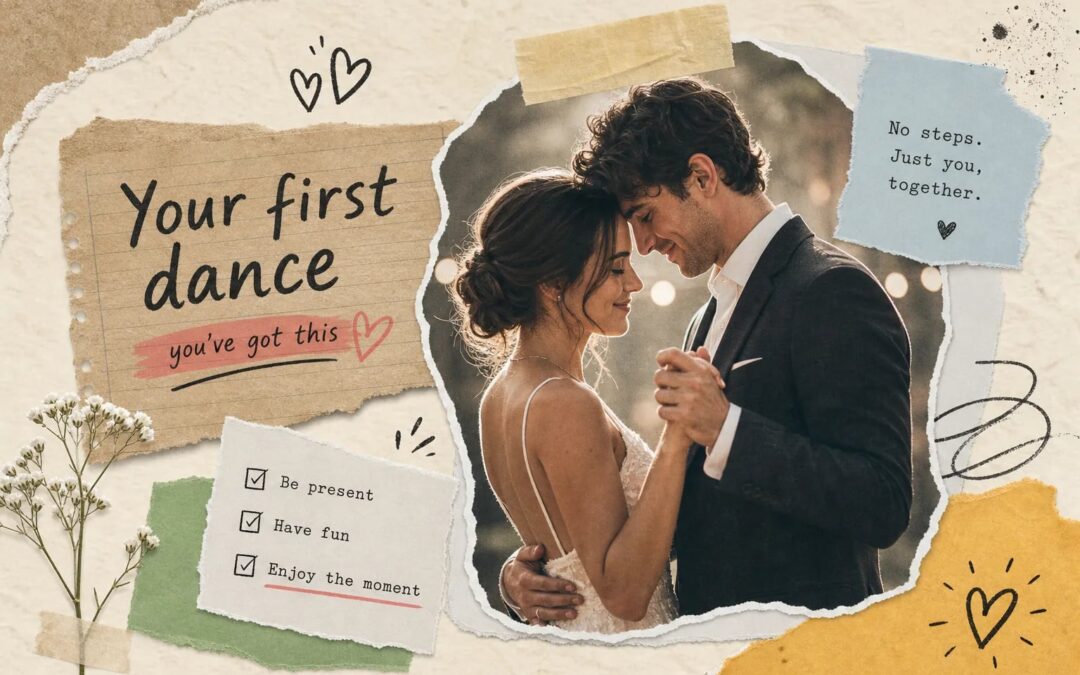
Picture this: you’re standing in the lounge room, your song is playing, and neither of you moves first. One of you laughs nervously. The other shuffles their feet. You both agree you’ll sort it out later, and later never really comes. That moment, equal parts awkward and completely human, is where most couples begin their first dance journey. If you’re looking for first dance advice with no experience, the embarrassment you’re feeling right now is real, and it’s worth naming directly: it has absolutely nothing to do with how good you’ll look on your wedding day.
At Suave Dance Studio in Sydney, our instructors have worked with hundreds of couples who walked through the door convinced they were beyond help. What we’ve found, every single time, is that no experience isn’t the problem. It’s actually the ideal starting point. There are no bad habits to unlearn, no half-remembered moves from a decade ago to untangle. You’re working with a clean slate.
This guide covers what you actually need: five simple moves that work in any space, a realistic six to eight week practice plan, clear song criteria, and the most common mistakes that make beginners look nervous when they don’t need to. By the end, you’ll know exactly what to do and when to do it.
Why the first dance feels harder than it actually is
Most people have already decided they can’t dance long before they set foot on a dance floor. That identity, “I’m not a dancer”, is the real obstacle, not the dancing itself. The first dance isn’t a performance requiring technical precision; it’s a moment between two people in front of a room full of people who love them and are actively cheering for them to succeed. Your guests are not critiquing your footwork. They’re watching you smile at each other.
Confidence on a dance floor comes from two things: knowing what your next move is, and being comfortable with your music. Neither requires natural talent. Both are learnable within a few weeks. When you have a small, reliable set of moves in your body and you’ve heard your song enough times that its structure feels familiar, the nerves drop significantly. Not because you’ve become a dancer overnight, but because you’re no longer improvising. That sense of knowing what comes next is the whole game.
This is the core of any solid first dance advice for beginners with no experience: simplicity and repetition beat complexity and ambition every time.
First dance advice with no experience, five beginner-friendly moves
You don’t need an elaborate routine. For most beginners, a small repertoire of dependable moves is far more effective than a complicated sequence that falls apart under pressure. These five work in any space, including small reception venues, and are all suited to wedding attire. Consider this your essential starter kit of first dance tips for beginners.
- Basic sway: Shift weight gently from side to side without travelling anywhere. It’s simple, romantic, and incredibly forgiving of a gown hem or a fitted suit jacket.
- Step-touch: Step to one side and bring the other foot in, then repeat in the other direction. It stays narrow and pairs well with a slow song.
- Box step: A small square pattern, forward and side and together, then back and side and together. Keep the steps compact; large steps increase the chance of tangling with a dress or losing your balance.
- Half-turn: A slow rotation together, staying close. It adds visual variety without needing floor space or significant technical skill.
- Underarm spin: One partner lifts a hand and guides the other through a slow, controlled turn. Keep it unhurried, especially in formal wear, so the fabric stays manageable.
Once the foundational three, sway, step-touch, box step, feel natural without conscious thought, add the half-turn and underarm spin for variety. Practise both in your actual wedding shoes before the day. Heel height and floor surface change how a turn feels considerably, and discovering that surprise on the night itself is something worth avoiding.
How to pick your song when you have no dance background
Song choice is one of the most consequential decisions a couple with no experience makes, and it’s often underestimated. The wrong song can make simple moves feel impossible; the right one makes you look far more capable than you think you are.
Aim for a mid-tempo song with a clear, steady beat. For easy swaying, songs in the 60 to 80 BPM range are the most forgiving. If you want a slightly more energetic feel, up to around 100 to 110 BPM can work well. Avoid songs with sudden tempo changes or irregular rhythms, simplicity in the music makes the dancing significantly easier. Length matters just as much: a two to three minute edit is the sweet spot for most beginners. Anything longer amplifies nerves, and anything shorter can feel rushed and unresolved.
The most reliable test is to put your shortlisted songs on and sway together in real time, in your living room, right now. You’ll know within 30 seconds whether the beat feels clear and where the natural phrase endings fall. Songs with obvious sections, verse, chorus, a strong finish, give you built-in moments to turn or change position without having to count constantly. Among the most popular choices for Australian couples in 2026, songs like “Perfect” by Ed Sheeran, “A Thousand Years” by Christina Perri, and “Can’t Help Falling in Love” remain reliable for non-dancers because they’re steady, emotionally clear, and structurally predictable.
First dance advice with no experience: a 6, 8 week practice plan
The single biggest mistake couples make with self-directed practice is treating it like a school assignment, cramming a long session in occasionally and wondering why nothing sticks. Muscle memory doesn’t work that way. Short, frequent sessions outperform long, irregular ones every time.
In weeks one to four, the focus is learning and repetition. Three to four sessions per week of 20 to 30 minutes each is the target. At this stage, you’re drilling the same moves until they stop requiring conscious thought. A 20-minute session four times a week produces better results than a two-hour block on the weekend. Work on one move at a time, then link them together once each feels solid individually.
In weeks five to eight, shift from drilling to running the whole dance. Practise from start to finish with the full song, in your wedding shoes, and in whatever space you have available. If something goes wrong during a run-through, keep moving. Stopping is a habit that carries onto the day, and a couple who recovers smoothly always looks more composed than one who freezes and restarts. The goal in this phase is rhythm and calm, not perfection.
This bride and groom first dance approach, consistent short sessions over six to eight weeks rather than last-minute cramming, is the most dependable path from anxious beginner to genuinely ready.
The mistakes that make beginners look nervous (and how to fix them)
There are a handful of tells that signal nervousness to a room, and none of them require any dancing ability to fix. The most common is looking down at your feet. It breaks the connection between partners, disrupts balance, and immediately signals anxiety to every guest in the room. Keep your chin up and your gaze toward your partner or just over their shoulder. That single adjustment transforms the feeling of the whole dance.
Alongside the gaze, maintaining a basic frame makes movement look intentional rather than accidental. You don’t need to master ballroom posture; you just need to avoid slumping. Keep your shoulders down and wide, your elbows softly rounded and slightly forward, and maintain a light tone through your back and core. The frame should feel supported, not rigid. Gripping your partner too tightly is just as disruptive as going completely limp.
Rushing the beat is almost universal among nervous dancers. When adrenaline kicks in, tempo tends to accelerate. In the weeks before the wedding, practise your routine at about 80% of full tempo occasionally, so you build awareness of when you’re speeding up. On the day itself, take two or three slow breaths before the song begins. A simple technique: inhale through the nose for four counts, exhale for six. Repeat that three or four times before you step out, and keep your steps small and deliberate once the music starts. Small, controlled movement always looks better than large, uncertain movement.
When professional lessons make the difference
Online tutorials can show you the shape of a move, but they can’t see how you specifically hold tension in your shoulders, or tell you that your timing is drifting by half a beat on the turn. A qualified wedding dance instructor gives real-time feedback and adjusts choreography to your body, your song, and your actual skill level. That kind of personalisation is the difference between a routine that looks generic and one that looks as though it was made for you, because it was.
For most beginners, four to eight private lessons is enough to feel genuinely confident for a 60 to 90 second first dance. The key is starting early enough: book at least eight to twelve weeks out from your wedding date. Six months in advance is the safer choice during peak wedding season in Sydney, when studio availability fills quickly.
At Suave Dance Studio on Pitt Street in central Sydney, the Silver package of ten lessons is designed precisely for couples starting from zero. Our instructors specialise exclusively in wedding dance preparation, which means the choreography is built around your chosen music and what looks natural for two non-dancers, rather than a generic beginner syllabus. Lessons include music editing guidance and coaching on the specific conditions of a wedding day: the dress, the shoes, the venue floor, the nerves. For couples with no prior experience, that specialist focus is what takes you from anxious to genuinely ready. Get in touch with our team to find out which package suits your timeline and goals.
Your first dance doesn’t need to be perfect
No dance experience is the most common starting point for a first dance in Sydney and across Australia. It’s not the exception; it’s the norm. The couples who look natural on the floor aren’t the ones with natural talent. They’re the ones who started early enough, kept the choreography simple, and practised consistently until the moves stopped feeling like moves and started feeling like just moving together.
The best first dance advice for couples with no experience is deceptively straightforward: start with five reliable moves, choose a song with a clear beat and an edited length of two to three minutes, build a short practice routine you can repeat without thinking, and run the whole thing in your wedding shoes before the big day. Those steps alone will put you ahead of most couples who leave it too late and hope for the best.
Your first dance doesn’t need to be flawless. It just needs to feel like yours.