
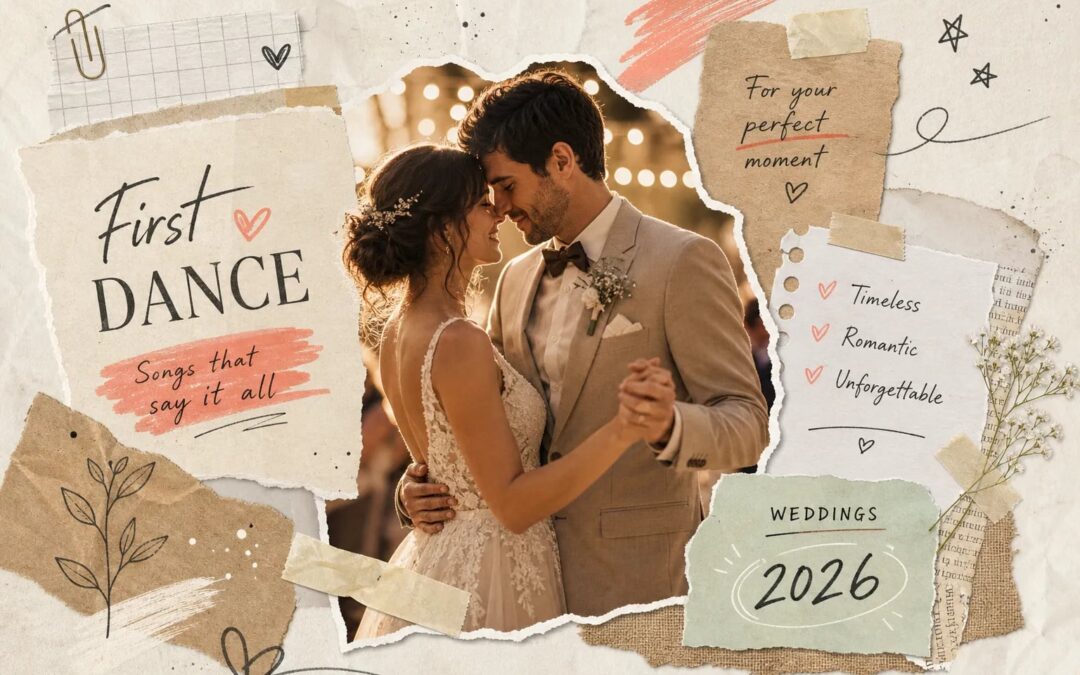
Choosing a first dance song feels like the smallest decision on your wedding planning list until, suddenly, it feels like the biggest one. The music sets the emotional tone of your first few minutes as a married couple, and every guest in the room has their phone raised and their eyes glistening. The pressure is real: there are too many options, too much at stake, and never quite enough time to think it through properly. This guide is a practical curator’s shortlist for Australian couples in 2026, not a generic playlist dump. Here’s what you’ll find: what actually makes a song dance-floor-ready, which international and Australian tracks are earning their place on wedding first dance playlists this year, how to match the mood to your moment, and the practical steps to take once you’ve found your song.
What makes a first dance song actually work
Before you fall in love with a track that’s impossible to dance to, it’s worth understanding the technical foundations that separate a great first dance song from a frustrating one. Tempo, length, and lyrics all need to align with how you plan to move and what you want your guests to feel. Getting these three factors right before you build a shortlist saves an enormous amount of frustration once lessons begin.
The tempo sweet spot for different dance styles
Tempo is the single factor most couples overlook until they’re already standing in the studio wondering why a song they adore feels impossible to move to. Songs in the 60 to 90 BPM range suit a gentle sway and are the most forgiving for couples without formal training. A formal Slow Waltz sits a little higher, typically around 84 to 96 BPM, which gives it that flowing, unhurried quality while still providing enough rhythmic structure to follow. Ed Sheeran’s “Perfect” falls comfortably within that waltz-friendly band, which is part of why it works so consistently for couples building their first choreography. Once you move above 110 BPM, intentional footwork and proper choreography become essential to looking polished rather than chaotic.
Length and the case for editing your song
The ideal first dance runs between 2.5 and 3.5 minutes. Most studio tracks run 4 to 5 minutes, and that gap matters more than couples expect, especially when guests are standing, watching, and silently counting down. A trained DJ or audio engineer can fade or trim the song to a natural endpoint, but this conversation needs to happen well before the wedding night, not in a rushed last-minute message. If your routine involves choreography, that performance section is typically 60 to 90 seconds, so the edit needs to accommodate a graceful transition from polished movement into a relaxed sway to close.
Lyrics that hold up in front of 100 guests
Guests listen closely during the first dance because the room is quiet and attention is undivided. Always listen to the full track, verses included, not just the chorus you know by heart. Some beloved songs contain unexpected lyrical turns that read awkwardly in a wedding context, and discovering that on the day is not the surprise you want. Choose lyrics with a clear emotional arc, and prioritise a song that honestly reflects your relationship over one that simply sounds “wedding-appropriate.”
International songs topping Australian wedding playlists in 2026
The global hits that dominate Australian wedding playlists aren’t there by accident. They’ve earned their place because they work on the dance floor, photograph well, and carry the emotional weight the moment demands.
Ed Sheeran, John Legend and the modern romantic ballad
Ed Sheeran continues to dominate Australian wedding playlists in 2026, with “Perfect” and “Thinking Out Loud” consistently sitting at the top of request lists. John Legend’s “All of Me” sits alongside them as a modern classic that has never faded from favour. What makes these songs so enduringly popular is a tempo that’s forgiving for beginners and musical builds that give choreography real room to breathe, the lyrics feel personal without being overwrought, which is harder to achieve than it sounds. These aren’t safe choices by default. They’re popular because they work.
Songs picking up serious momentum this year
“Die With a Smile” by Lady Gaga and Bruno Mars brings an uplifting, dramatic energy that has earned it a firm place on 2026 shortlists across Sydney studios. RAYE’s “Where Is My Husband” is being requested specifically for choreographed entrances and surprise routines, driven heavily by wedding content on social media. Alex Warren’s “Ordinary” has emerged as one of the most-requested new first dance songs of 2026, its emotional directness striking a chord with couples who want something that feels current rather than borrowed from a decade ago. Taylor Swift’s “Lover” continues to appeal to those wanting a retro warmth, while James Arthur’s “Say You Won’t Let Go” and Lewis Capaldi’s catalogue are appearing more frequently in lesson requests, grouped together by a shared quality of raw, unguarded sentiment that translates well to an intimate room.
Timeless classics with enduring appeal
Elvis Presley’s “Can’t Help Falling in Love” has seen a genuine revival in recent years, and it shows no sign of fading. Etta James’s “At Last” remains a go-to for couples wanting something cinematic and soulful, with the added advantage of gender-neutral lyrics that work beautifully for any couple. Ben E. King’s “Stand By Me” carries a different mood: slower, more intimate, and quietly powerful. These songs have survived decades of weddings because they were written to carry weight, and they still do.
Australian artists who deserve a spot on your shortlist
There’s something deeply moving about walking onto the dance floor for the first time as a married couple to a song that belongs to this country. Australian tracks bring a layer of cultural identity to the moment that an international hit, however beautiful, simply can’t replicate.
The iconic Australian picks that never date
Few songs match the dramatic string arrangements and cultural gravitas of INXS’s “Never Tear Us Apart”, its tempo and build create natural choreography moments, and it photographs exceptionally well. Written with the patience of a slow, beginner-friendly rhythm, Savage Garden’s “Truly Madly Deeply” has lyrics that feel almost purpose-made for a wedding vow exchange. “The Horses” by Daryl Braithwaite carries a nostalgic weight that resonates deeply with Australian couples. Guy Sebastian’s “Angels Brought Me Here” builds cinematically and lands hard emotionally in a way that is almost impossible not to respond to. Each of these tracks earns its place on technical grounds, tempo, arrangement, and lyrical clarity, as much as on emotional ones, and that combination is rarer than it appears.
Modern Australian voices for a contemporary first dance
Amy Shark’s “Adore” has earned a devoted following among couples wanting something intimate and indie rather than grand and orchestral. Dean Lewis’s “Lose My Mind” suits an acoustic, stripped-back ceremony where the mood is private and heartfelt rather than performative. For weddings with a folk, garden, or winery atmosphere, The Paper Kites’ “Bloom” is worth serious consideration: it’s quiet, unhurried, and quietly stunning in a live room. Keith Urban and Delta Goodrem remain reliable choices for couples who skew toward country or classic Australian pop, and both artists have catalogues deep enough to find something that fits your specific story.
Matching your song to your mood, dance style and guests
The best way to choose a first dance song isn’t to scan a list until something sounds familiar. It’s to decide what feeling you want to create in that moment, then find the song that delivers it.
Slow and romantic: songs that suit a waltz or gentle sway
For couples who want something unhurried and elegant, the 60 to 90 BPM range is ideal for a gentle sway, while a formal Slow Waltz typically calls for something in the 84 to 96 BPM band. Songs written in 3/4 time give the dance a flowing, circular quality that photographs exceptionally well and feels effortless even for beginners with solid foundational training. Tracks like “Thinking Out Loud,” “The Horses,” and “At Last” are commonly chosen for slow, romantic first dances, verify the final edit against your chosen style’s tempo before locking anything in. This is the right choice for couples who want elegance over energy and a first dance that feels timeless rather than showy.
Upbeat and celebratory: when choreography is the point
Some couples want the first dance to be a genuine performance that earns a reaction from the room. For those couples, tempo is their friend. Songs like “Die With a Smile,” “Never Tear Us Apart,” or something with a Latin rhythm open the door to choreographed footwork, turns, and moments of real flair. These routines require more lessons and more committed practice between sessions, but the payoff is a moment guests remember and talk about long after the night is over.
Inclusive choices for all couples
Gender-neutral lyrics matter, and they’re worth checking before you commit to a song. “At Last,” “Thinking Out Loud,” “How Long Will I Love You” by Ellie Goulding, and “Stay With Me” by Sam Smith all use “you” throughout, making them versatile for same-sex couples and non-traditional ceremonies. Troye Sivan’s “Angel Baby” and Mary Lambert’s “She Keeps Me Warm” carry added personal significance for queer couples who want the song itself to reflect who they are. The right song is always the one that reflects the couple standing in the room, regardless of who that couple is.
From song choice to the dance floor
Choosing the song is only the beginning, what comes next is where the real work and the genuine enjoyment happen. Two practical steps determine whether the moment lands the way you’ve imagined it.
Briefing your DJ or live band on edits and timing
Once your song is chosen, communicate your edit requirements clearly and early. Your DJ or band needs to know the preferred start point, the preferred end point, any mid-song style changes, and whether you want a natural fade or a full stop. Share this information at least four weeks before the wedding, and provide a labelled audio file rather than a streaming link so there’s no version confusion on the night. Rehearse exclusively to the final edited version, not the original studio track, because any timing differences between the two will show up exactly when you don’t want them to.
How a specialist dance studio turns your song into a moment
Choosing the song is step one. Learning to move to it in a way that feels natural and looks polished is where the transformation happens. Working with a specialist studio means having guidance on music selection and editing built into the lesson process, rather than navigating tempo questions, BPM ranges, and edit decisions alone. Wedding Dance Lessons Sydney (Suave Dance Studio) , based in the Sydney CBD, structures lessons around each couple’s specific song, style, and timeline, so the routine you build is tailored to your choices, not adapted from a generic template. That combination of music expertise and choreography coaching is what transforms a first dance from something couples simply get through to something they walk away proud of.
The song is chosen. Now it’s time to dance.
The first dance is a two-minute window where the rest of the room disappears and it’s just the two of you. The song you choose shapes everything about that feeling, from the pace of your breath to the way the room responds when the music fades. The practical filters are straightforward: match the tempo to your dance style, keep the edited length between 2.5 and 3.5 minutes, and choose lyrics that honestly reflect your relationship. If you want the moment to feel locally rooted, Australian artists are worth serious consideration.
Once the song is locked in, the real work, and the real fun, begins. The best wedding first dance songs in Australia are only as powerful as the couple dancing to them, and that’s exactly where working with a specialist makes all the difference. Book a consultation with Wedding Dance Lessons Sydney (Suave Dance Studio) and let experienced instructors take the guesswork out of both the music and the movement. Your first dance is too important to leave to chance.